Pages

Showing posts with label Teaching Aids. Show all posts

February 24, 2012

The Best Of: New Games and other stuff Edition

Welcome to The Best Of: where I round up some great links for you from around the www. that I have enjoyed this week!


Piano Finger Twister from Joy (looks like so much fun!)

Smash Hit Games with the Eggspert (again, why can't I be the student?)

Jennifer uses the Eggspert Quizzing System to play Accidental Adventure

Want to listen to some phenomenal pianists? Listen to music from Carnegie Hall!

Here are the goodies: Hal Leonard is offering 40% off select teacher resources until the end of March!

Slightly humorous, but so very important are the truths in this post about the person hiding in your church's back closet!!!!


Any other great links that you have read this week that you would like to share with us? Please do!


July 14, 2011

An App Giveaway

It seems like most piano teachers I read about these days are getting iPads for their studios. They sound like so much fun! I can't wait for the day that I can add one to my "teaching materials." (Solely for teaching, I assure you....ok, maybe not!) Actually my brother is entered to win one, and he is VERY sure he is going to win...and when he does he is going to give it to me, because he has no need for it, right? RIGHT?

Anyway, I enjoy reading about all the great apps that are out there in relation to teaching, and I can't wait for the day that I get to try them out. I have wondered, though...how on earth will I remember all these great apps? I can just see myself doing searches for "apps" on all of your blogs to see the ones you use. I will probably post a question on my blog, "What great apps are out there for teaching? What apps do you use in your studio?" I will search high and low for the best apps, comparing all those metronomes, and finally settling on what I think I will use the most.

OR,

I could compile all of your "app" posts into one convenient list so that not only me, but other piano teachers who add an iPad to their studios will have a place to go read the reviews about teaching apps.

Bingo!

Much like I did with the recital posts, I can keep updating this list with apps that you all think are great. I am going to begin putting this list together, so if you have blogged about an app that you would recommend, please leave a comment and let me know!

And in the meantime, Natalie from Music Matters Blog is hosting an app giveaway as we speak! Not just one, but TWO great apps, with three copies of each being given away. So you have six chances to win! So head on over to her review to leave your comment to enter and (hopefully) win!

May 16, 2011

Large Staff Fun - And A Printable!

I mentioned before how I made my large staff. Seriously, we use this thing all the time! It is great for working on space/line notes, note names, intervals, just about anything!

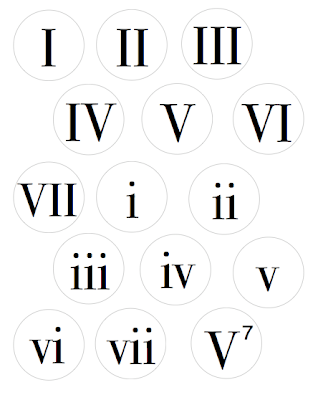
Today I'd like to show you how I use it to work on scale degrees and chords. I made these circles to fit on the lines and spaces so that we could "label" our "notes." Here we have a scale all written out (minues the accidentals, I know...we weren't too worried about that at the moment!) with the scale degrees, and we worked on building the primary chords for that scale.


As you can see in that first picture, I have more circles made out to cover every Roman Numeral that we might need. Or at least, all the ones I could think of! This way we can always use them to review major/minor chords, intervals, etc.

Now, to make mine, I just used card stock and some colored markers and did it all by hand. It was simple. Sometimes I like to do things by hand rather than print everything off the computer. But some of you may prefer to have these handy to print out, so I also made them into a printable for you. Aren't I nice? And I even have one in black and white, to be printed on colored card stock, and one in color, to be printed on white card stock. Aren't I even nicer?

Each file is two pages, one with Roman Numerals and one with numbers. The circles are 4.45 cm. in diameter, to give you an idea of the size.

I'd be delighted to hear how you use these circles!

May 10, 2011

Guest Post: Enjoyable Piano Lessons???

♬ Guest Post ♬


Enjoyable Piano Lessons???

Discovering a Relative and Fun Method to Piano Teaching

By Emily Matthew


I believe a tragedy has occurred in both piano studios and student’s homes across the country. Piano students dread going to lessons because their teacher is “boring” or “strict”; teachers are unoriginal and rigid in their teaching styles; and parents are tired of the constant battle to practice. The result? More students discontinue piano lessons. This is a problem that I believe could be corrected by parents and piano teachers, both of which who will in turn influence the students.


This article is not intended for parents; however, I will quickly say this: I believe it is the parents’ responsibility to give their child the opportunity of music lessons. I believe that learning to play an instrument is a necessary discipline in the life of a child, both musically and otherwise. Learning an instrument instills in a child invaluable qualities that will benefit him throughout all his life. I believe it is the parents’ job to support piano lessons just as they do math, history, and science classes in school. If your child did not enjoy math homework, would you allow him to drop out of math class? Of course not! I’ve had parents tell me that they wish their child had a desire to take music lessons, but since their child isn’t interested in music or committed to practicing, they will not be required to take lessons. I really believe that is sad! While a career in music isn’t for everyone, I do believe that several years of musical discipline are necessary for a child’s education. However...that is another subject for another time!


Now for the teachers: I believe it is your responsibility to foster in your students a love for music. Let’s face it: many a student will end up in our studios who really doesn’t want to be there. He, in fact, is determined to hate the piano. Bravo to the parents who make him come! It is now the teacher’s job to convince him that music can be rewarding and even fun. James Bastien said, “The teacher, not a set of books, is the determining factor in quality results.” The teacher should demonstrate to him the great fulfillment and enjoyment that can be had from music lessons.


Private piano teachers today are competing with a multitude of other activities that are vying for their students’ attention. Sports, movies, video games, and other modern entertainment are FUN! Why would your student want to sit 1/2 hour with someone who is twice his age explaining to him how to interpret little black dots on a page full of lines? If you were in his place would that be fun to you? I believe it is time for teachers to step back and re-evaluate their teaching methods. I am NOT advocating reducing a high quality of a musical education. I am definitely not suggesting that you throw out theory, scales, and classical study or that you lessen your high standards for performance. My students spend plenty of time investing in these areas, and they also know that doing less than their best is simply not an option. What I am suggesting is that you adapt your presentation of these musical areas to make them appealing. Ignite your student’s curiosity about theory. Make him want to master the last scale in his book before anyone else has ever done. Fascinate him with the classical masterpieces and the men who wrote them. Make music come alive!!!


I believe piano lessons can come alive by the teacher being real, relevant, and enthusiastic about what he is teaching to his student. Get to know your students. Discover their learning style and use that knowledge as a stepping stone to bring them to the realization that music can be enjoyable. Do crazy things during your lessons to make your students laugh and relax. My students and I have come up with the strangest and craziest stories that express the mood of a song they are learning; but you know what? After coming up with those “silly” stories, they play the song better and they enjoy doing so! It’s amazing! Hold studio competitions for titles in the “Piano Hall of Fame.” Use colored pencils and highlighters in the child’s favorite color. Play musical games, with the challenge that you’re pretty hard to beat. I appreciate what a Chinese Proverb states, “Tell me and I will forget; show me and I may remember; involve me and I will understand.” Make each minute of lesson time count by actively involving students and doing your best to make lessons enjoyable. Be relative to your students, and please don’t lose another student simply because he was bored with you.


In my piano studio, I strive to give my students a quality musical education. We do all the “boring” stuff such as theory books, scales, arpeggios, Hanon, classical music, but *read* it is not boring to the majority of my students. Why? Because I have strived to make it enjoyable for them. I hold studio competitions year round (with fun names, of course). Last June and July, I hosted “Sizzlin’ Summer Studies”, where students could become “Piano Superstars” by completing some tricky assignments. During the majority of the year, I hold a much more in- depth competition. Last year, we embarked on “Treasures from the Past: the Lives of Great Composers.” We spent the year with an emphasis on classical music. My students had the options of listening to classical music, completing extra credit worksheets, playing additional songs at the foremost level of excellence, working extra hard on their given assignments, practicing extra time, etc. all for the purpose of earning “Treasure Chest Coins” which could be traded in for some awesome prizes. I hardly heard any complaints about practice time or scales. Two of my students were so competitive about the contest that they called each other during the week to see how many “Treasure Chest Coins” they were going to earn that week to see if they in turn needed to practice more or do some extra work. Those two students tied as winners of the contest. They surpassed my musical expectations for them! They learned so much more than I required of them and enjoyed doing so! Why? I suggest that it was at least partially because piano learning was made fun.


I believe another huge motivator is simply your praise. I can’t remember where I once heard this suggestion, but it has been a huge help to me! “Never let a lesson go by without praising your student about something they did well.” Now, I will admit, this can be very difficult at times! Maybe your student didn’t practice at all, missed most of the notes in his song, and completely ruined the rhythm...well, use your imagination to find something good that he did do! :) Time for some out-of-the-box thinking! What about his dynamics (on those few notes that were correct that is)...praise him for it. Try this, “Billy, you have some incredible dynamics while you’re playing! I especially like that forte at the very end! It sounded just like a lion roaring!” Of course we need to address the problems too, so then try this: “You know Billy, we really need to get these notes and rhythm right. I can’t wait to hear it next week! I know once you get those things right, it will sound amazing with those incredible dynamics I already heard today!” What do you think? I think that it helps your student see that you’re not “against” him. Find something he did right and tell him how much you like it!


You may be reading this and thinking, “This is all great, but I don’t think it will solve all my ‘bored student’ problems.” You’re right. It won’t. But, you’ve done your part; now, just keep trying! Keep getting to know your students as individuals, and find one thing that they enjoy doing that motivates them. Once you’ve found it, use your imagination and work with that knowledge! On my beginning student/parent questionnaires, I ask the parents their child’s learning style, temperament, and motivators. I have found those answers to be so helpful to me as I teach! If you have a majority of “bored students” in your studio, why not try a few new and innovative ideas? Those bored students just might change their minds!


Are your students having fun during their lessons, or do they dread them? I suggest that you re-evaluate your approach to teaching. Become a relevant teacher and motivator rather than a strict and strenuous instructor. It is our responsibility as music teachers to do our best to instill in our students a love and a passion for the instrument we teach.


Emily Matthews and her husband Jared currently live in Minnesota, where Emily enjoys being a homemaker and piano teacher. You can visit her piano studio website to see what she's all about. Emily is also an avid couponer and blogs about her homemaking and couponing adventures on their blog, Day by Day.

April 23, 2011

Organizing Some Teaching Materials

At the beginning of the year I shared a little bit about how I keep some of my teaching files organized. Keeping things organized in a way that works best for us is a never-ending process. As the weeks go by, things change. We get more students. We print off about a thousand more worksheets and games. What we tried before isn't working as well as we want it to. So its time to try something else. That is the key to organizing...finding what works best, even if it takes a bagillion tries. (Think Thomas Edison thoughts)

So I decided to get some of my games and teaching aids a little more organized. I already had this expanding file, and I was already keeping all of these same things in it. But sometimes it was hard to find what I needed, and I was often forgetting about some of the great resources I had. I wanted to be able to see at a glance what all I had available.

So, I added some file folders to the expanding file. I labeled them with bright colors (because I {heart} bright colors) and presto! It made a world of difference!


Now I have it mostly organized with one pocket for teaching aids, one pocket for games, etc. The front two pockets hold some miscellaneous things that wouldn't fit as well in a folder. I can easily see them, anyway. I found that adding the folders made everything fit into the file better, and it became less bulky.

Now all I have to do is glance through the file, take out the game that I am looking for, and pop it into my students folder to take with me to the lesson that week. Phew, isn't lesson planning hard??? :)
So rather than, "Umm, just a minute.....I have this great game I want to play....it was right here last week.....it really is a great game, you'll love it.....ah, here it is! Wait, wheres that other part....." You get the picture. This has made planning out my lessons much easier!

I have two other expanding files with teaching things in it, only they are the half-sized ones. I don't think they make half-sized file folders! Anyone have any other ideas??

Have you been doing any organizing? I would love to see how you keep your teaching aids and games organized and easily accessible!

April 13, 2011

Musical Alphagems

I was finally able to make the Musical Alphagems that Joy shared several months ago. I had a little bit of a hard time finding the clear glass gems. The ones I finally found aren’t that great. I had to discard half of them because of imperfections in the glass, but I was able to do a few.

Joys tutorial was very easy to follow, and my gems came out just like I wanted them to! I am so thankful for the printable that Joy made to aid in cutting these little babies out. It makes for tiny pieces of paper!


I have already used them with a couple of students. I took two of each letter and shook them up and then had my beginning students see how fast they could put them on the piano. These gems are great because they fit easily on the keys. So far my students have seemed to enjoy them and did well with this little challenge.

If you have the resources to make these gems, I encourage you to do so! They are a great addition to any studio.

April 6, 2011

New Lesson Props

I picked up a couple things at my local Dollar store that have proven to add some fun to lessons. Here they are, with some of my ideas to use them.

This big clothespin is inspiring! I have it displaying the coveted "One Minute Cards" right now, but it will change occupation soon. It sure catches my students eyes when they sit down at the piano.

This is a dry erase board. I have a 7-year-old student that speaks English, but has only learned to read and write French. So I picked this up to practice spelling some words like rhythm, slur, quarter note, etc. I would write the first letter of the word and see if he could guess what I was spelling. He guessed "rhythm" on the first letter. I got him on "octave," though. :) Then I had him copy each one. He seemed to enjoy it...and enjoyed showing his mother when he was done!

Here is what the back of the board looks like:

All my young students are really into Toy Story right now, so having this as an alternative to the normal "white board" will be fun.

Any suggestions on other ways I could use these?


March 22, 2011

My Favorite Flashcards

I have mentioned once or twice my insane love of the color-coded flash cards that I use. Here are my reasons why!

They are colorful. I am all about anything colorful, and we all know that bright colors appeal to kids, and many times to adults, too!


They are inclusive. They cover practically everything a student needs to know for a very long time. In fact, off the top of my head I can’t think of anything else a student could drill! Here’s the breakdown:

Yellow: Clef signs and all notes on staff and ledger lines

Pink: Note values, time signatures

White: Musical terms, tempo marks, dynamic signs

Green: Symbols

Blue: Key signatures and intervals

They have more uses than just being boring flashcards. Because they are cleanly printed and large enough to be clearly seen, they can be used to play games as well. Use your imagination! Don’t let them seem like a drudgery, find a way to make them interesting for your students. I shared here how I am using them to help my students into the One Minute Club. They are working extremely well for that purpose!


They are inexpensive. I usually order mine through alfred.com. (Note: When you go to check out, alfred.com will ask you to select a distributor in your area. I usually use musictime.ca or sheetmusicplus.com) I hesitated at first, wondering if it was worth it to buy flash cards or if I should just print my own freebies, but the reasons I mentioned above sold me very quickly. I think I may have pondered it for about 3.5 seconds. It is a wise investment of a few of our dollars!


Here is how I present them to a student the first time. For a beginner, I usually go through the yellow and pink sections and select the ones I feel appropriate for the student. I usually will start with the notes in the Middle C and C positions. I don’t want to confuse the student by giving them ledger line notes, etc. Depending on the student I may just give them the notes in Middle C position and add the others as they learn them. I also select the pink cards that they will learn first - 4/4 time, 3/4 time, quarter, half, and whole notes, etc.


I put these selected cards in a binder clip and assign those to the student for the first few weeks. (I do send all of the cards home with them, though, so that if they get ambitious and want to look through them they can.) For a young student I assign 5 minutes a day/5 days a week. For an older student I assign 10 minutes a day/5 days per week. I encourage them to take them with them when they go places that they will have a few minutes of extra time - waiting rooms, car rides, etc. Unlike regular piano practice, these can go anywhere!


I don’t drill the cards at every lesson, but I do at most. I think that this gives a little motivation for the student to spend quality time with their flash cards during the week. They know I will be checking up on how they are coming!


I also supplement flash cards with games and activities that go over the same notes. More about that here.


I encourage you to check out these flash cards for yourself! I think you will quickly fall in love with them as I did! And I would love to know how you use flash cards in your studio.


Note: I wasn’t paid or perked in any way to give this plug about these flash cards. I just seriously adore them and wanted to share the love! There is plenty to go around!

March 14, 2011

Teaching Aids: Grand Staff

Someone asked me to share how I made my staff sheets mentioned in this post. I use these over and over while teaching, as there are always things that need to be reinforced on the staff.


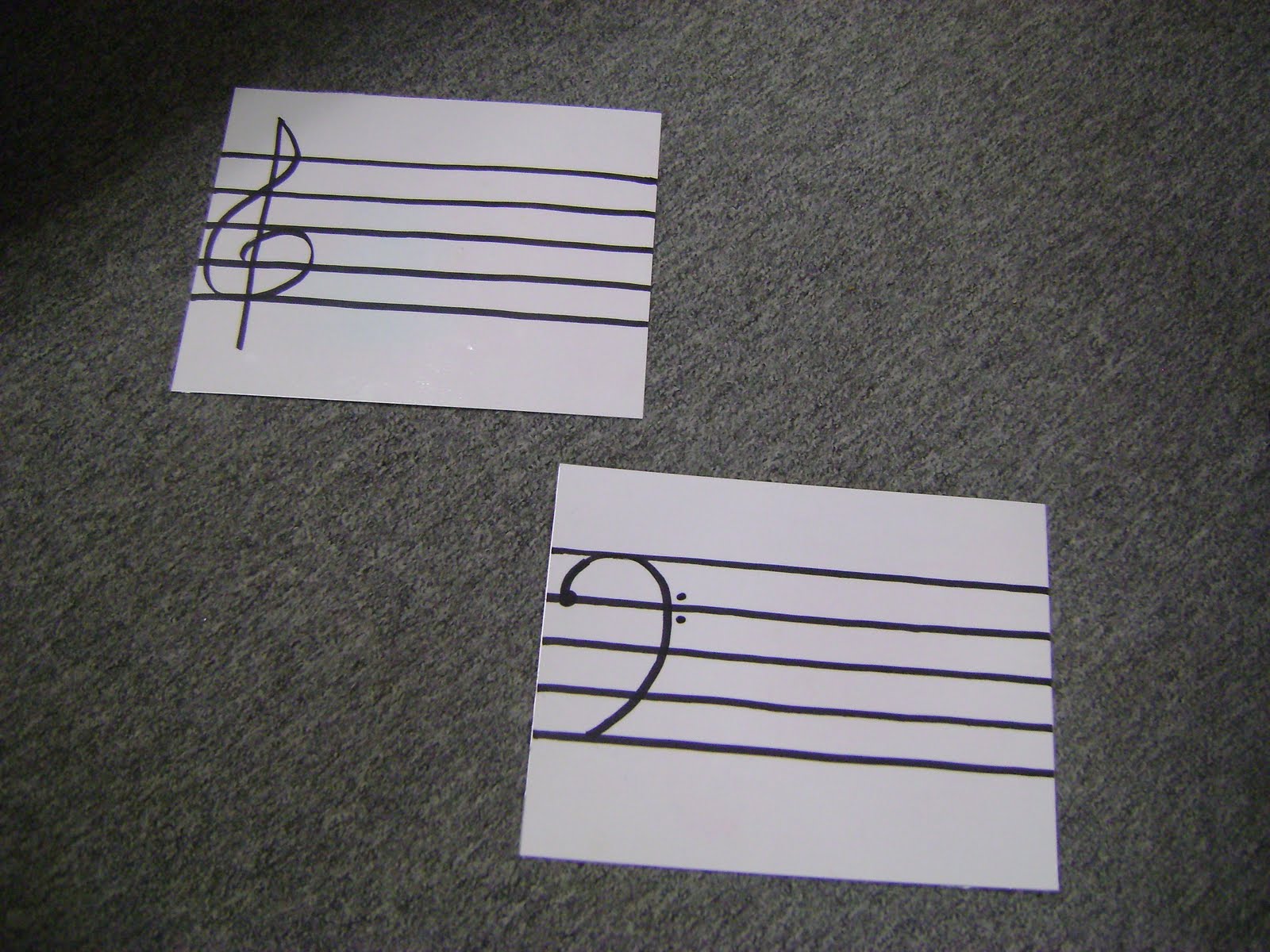
Here is a picture of the treble and bass staves I made when I was in college:

All I did here was take a black Sharpie to a piece of white cardstock. I use a ruler to (try to) make my lines evenly spaced and straight. I penciled it all in before I made it permanent, as my artistic ability is as lacking as my creative juices! :) I find these staffs plenty big enough to fill in note names, practice drawing notes, teach the stem rule, etc. Because they are laminated, we can write on them with dry-erase markers and use them over and over. I also made these notes and time signatures out of cardstock and had those laminated as well. This way a student can arrange measures of their own and then play them.

Here is my large staff, drawn on a poster board. I made this the same way as the others, only on a bigger scale. I had to use a yardstick instead of a ruler. :)

I cut the circles you see out of colored cardstock to fit this staff. I put numbers on some of them for a student to make major scales with scale degrees, or to make chords and intervals.


If you need a smaller staff, Susan Paradis has some printable ones on her site. (Scroll down this page to find the different ones.) Some have fun graphics, but there are plain ones as well. I have several of these laminated as well. I often pull them out at a moments notice to be able to demonstrate things on the staff without messing up my student’s book.


Hope this information is helpful! Has anyone else done DIY projects like this?